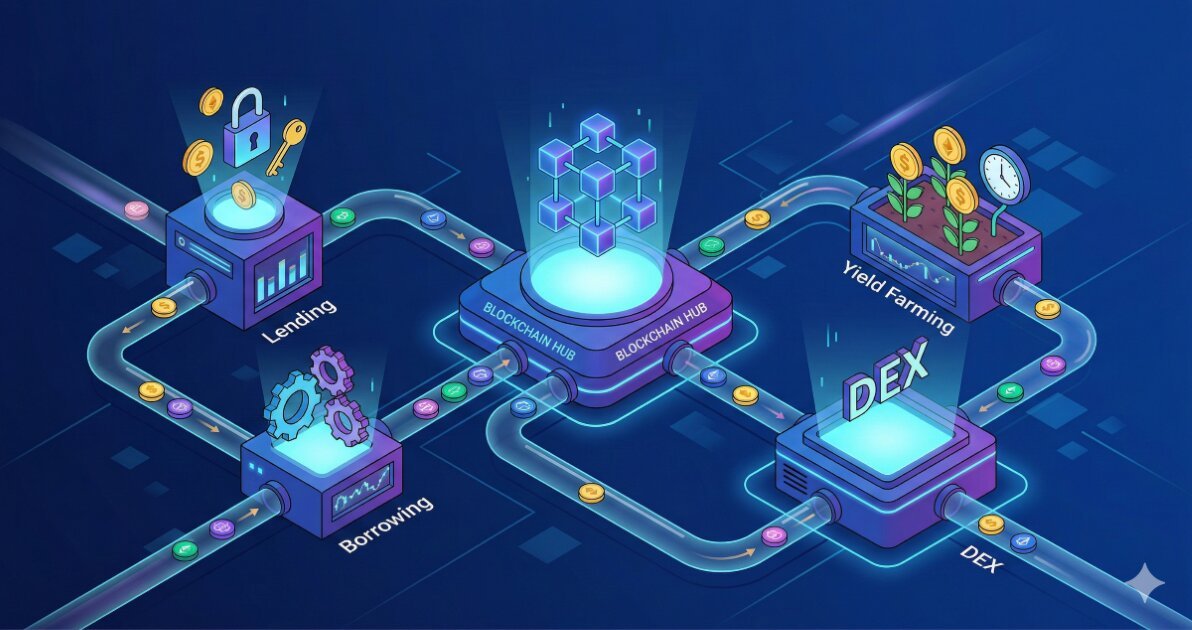
Building a crypto exchange requires decisions across regulatory compliance, custody architecture, liquidity design, and operational security. This article walks through the core subsystems, covering centralized and decentralized models, and identifies the technical and business choices that shape performance, risk, and market fit.
Choose Your Exchange Model
Centralized exchanges (CEXs) custody user funds, maintain an internal order book, and settle trades offchain. You control the matching engine, KYC pipeline, and withdrawal approval flow. This model offers low latency and high throughput but places regulatory burden and custodial risk on your entity.
Decentralized exchanges (DEXs) execute trades through smart contracts, typically using automated market maker (AMM) logic or onchain order books. Users retain custody. You deploy contracts, maintain a frontend, and optionally run indexing infrastructure. Regulatory posture shifts from money transmitter to software provider, though this varies by jurisdiction.
Hybrid models combine offchain matching with onchain settlement or introduce noncustodial custody via multisig or threshold signature schemes. These reduce latency versus pure DEXs but add integration complexity.
Design the Custody Layer
For CEXs, you need hot wallets for operational liquidity and cold wallets for bulk reserves. Hot wallets sign withdrawals automatically based on internal ledger checks. Cold wallets require manual or threshold signature approval and hold 80 to 95 percent of assets depending on trading volume and withdrawal patterns.
Implement address whitelisting, time delays for large withdrawals, and multisig approval thresholds. Monitor wallet balances in real time and reconcile against your internal ledger every block or every few minutes.
For DEXs, users connect web3 wallets. Your contracts never custody assets except during atomic swaps or in liquidity pool deposits. The security surface moves to contract logic, frontend integrity, and RPC provider trust.
Build or Integrate the Matching Engine
CEX matching engines consume order messages, maintain price-time priority queues, and emit fill events. Latency targets range from sub-millisecond for institutional venues to tens of milliseconds for retail platforms. You can build in-memory matching in C++ or Rust, or license a commercial engine.
Key parameters include tick size, minimum order size, and maximum orders per account. Enforce rate limits at the API gateway to prevent order spam. Support market, limit, stop-loss, and post-only order types as baseline functionality.
DEXs replace the matching engine with AMM curves (constant product, stableswap, concentrated liquidity) or onchain limit order books. AMMs execute swaps immediately against pool reserves, while onchain order books require taker transactions to match maker orders. Gas costs constrain order granularity and update frequency.
Establish Liquidity and Market Making
Bootstrapping liquidity determines whether the exchange survives the first 90 days. For CEXs, seed the order book with your own capital or contract market makers who commit to minimum spread and depth targets. Maker-taker fee structures (negative maker fees, positive taker fees) incentivize passive liquidity.
DEXs require initial pool seeding. Provide token pairs at target ratios and optionally offer liquidity mining rewards. Monitor pool balance drift and impermanent loss exposure. Integrate routing aggregators to pull in volume from other DEXs.
External market makers query your API every few milliseconds, cancel and replace orders, and arbitrage cross-venue spreads. Provide FIX or WebSocket APIs with bulk order operations and snapshot recovery to serve this flow.
Implement Compliance and KYC
CEXs operating in most jurisdictions must register as money services businesses or equivalent, implement Know Your Customer checks, and file suspicious activity reports. KYC vendors provide document verification, sanctions screening, and ongoing monitoring. Integrate these checks at account creation and enforce withdrawal limits until verification completes.
Maintain audit logs for all trades, deposits, and withdrawals. Build transaction monitoring rules that flag structuring patterns, rapid movement to mixers, or high-risk counterparty addresses. Report thresholds and requirements vary by jurisdiction; consult local counsel.
DEXs avoid direct KYC obligations in many regions but face increasing scrutiny if the frontend restricts access based on geography or if the protocol exhibits admin controls that resemble centralized operation. Frontend geofencing and IP blocking are common mitigations but are easily bypassed.
Secure the Infrastructure
Run exchange infrastructure across multiple availability zones with redundant databases and failover logic. Separate the trade execution environment from the cold wallet signing environment. Use hardware security modules (HSMs) or threshold signature schemes for hot wallet signing.
Expose APIs behind rate limiting, DDoS mitigation, and TLS termination. Implement two-factor authentication (2FA) for user accounts and admin access. Rotate API keys and database credentials regularly.
For DEXs, audit smart contracts before mainnet deployment. Use formal verification tools where applicable. Deploy proxy patterns for upgradeability but limit admin privileges to prevent rug scenarios. Run a bug bounty program and monitor contract interactions for anomalous behavior.
Worked Example: Processing a Market Sell Order
A user submits a market sell order for 2.5 ETH on a CEX. The API validates the user’s ETH balance in the internal ledger and checks account status. The matching engine consumes the order, crosses it against the top bids in the order book, and generates fill messages for three maker orders: 1.0 ETH at 2050 USDT, 1.0 ETH at 2049 USDT, and 0.5 ETH at 2048 USDT. The engine debits 2.5 ETH and credits 5123.5 USDT (2050 + 2049 + 0.5 × 2048) minus taker fees (typically 0.1 to 0.2 percent) to the user’s ledger. The makers’ orders are partially or fully filled, and they pay no fee or receive a rebate. The settlement system logs the trade, updates account balances, and triggers real time balance reconciliation. No blockchain transaction occurs unless the user withdraws.
Common Mistakes and Misconfigurations
- Storing private keys in application memory or environment variables. Use HSMs or secure enclaves for hot wallets and air-gapped signing devices for cold wallets.
- Running a single database instance without replication or point-in-time recovery. Exchange ledgers require multi-region replicas and continuous backup.
- Allowing unbounded order placement without rate limits or capital checks. Order spam can saturate the matching engine and create denial of service conditions.
- Failing to reconcile internal ledger balances with on-chain wallet balances. Discrepancies indicate logic bugs, withdrawal fraud, or accounting drift.
- Deploying DEX contracts without timelocks or multisig admin controls. Single admin keys enable instant rug pulls and attract exploits.
- Ignoring slippage and frontrunning on DEXs. Market orders on AMMs execute at whatever price the pool offers after pending transactions clear, which can deviate significantly during volatility.
What to Verify Before You Rely on This
- Confirm the regulatory classification of your exchange model in your target jurisdictions. Money transmitter, securities exchange, and payment processor rules differ across regions.
- Check current KYC vendor API uptime, verification speeds, and sanctions list coverage. Vendor outages block user onboarding.
- Verify the audit status and upgrade history of any smart contracts you deploy or integrate. Look for formal verification reports and bug bounty results.
- Review the fee structure and liquidity of competing exchanges. Maker-taker splits, withdrawal fees, and spread width determine whether you can attract volume.
- Test disaster recovery procedures, including database failover, wallet key recovery, and matching engine restarts. Document recovery time objectives and runbooks.
- Monitor applicable stablecoin reserve transparency and depeg risk if your exchange uses stablecoins as quote assets. Reserve composition affects user confidence and liquidity.
- Evaluate custody insurance options and coverage limits. Many policies exclude smart contract exploits or require specific security controls.
- Assess RPC provider reliability and rate limits if running a DEX frontend. Provider outages or throttling break user interactions.
- Confirm the legal entity structure and liability separation between the exchange operator, token issuer (if applicable), and custodian. Commingling roles increases risk.
Next Steps
- Draft a jurisdiction-specific compliance roadmap covering registration, KYC requirements, and reporting obligations. Engage legal counsel before onboarding the first user.
- Build a minimum viable matching engine or AMM prototype and load test it under realistic order flow. Measure latency, throughput, and error handling before scaling.
- Establish relationships with liquidity providers, market makers, and blockchain infrastructure vendors. Negotiate service level agreements and fee structures early.
Category: Crypto Exchanges