A crypto exchange is a platform that matches buy and sell orders for digital assets, either by maintaining a centralized order book or by routing trades through automated market makers and liquidity pools. Understanding exchange architecture matters because custody model, settlement mechanism, and regulatory posture determine counterparty risk, capital efficiency, and available recourse when trades fail or funds disappear.
This article covers the structural differences between centralized and decentralized exchanges, how order matching and settlement work under each model, custody and key management trade-offs, and the failure modes practitioners encounter in production.
Centralized Exchanges: Custody and Internal Ledgers
A centralized exchange (CEX) holds user funds in omnibus wallets it controls. When you deposit, the exchange credits an internal database entry to your account. Trades execute by updating rows in that database. No onchain transaction occurs until you withdraw.
This architecture enables high throughput. Binance, Coinbase, and Kraken process millions of trades per day because matching happens in memory against a central limit order book, not by broadcasting transactions to a blockchain. Latency stays under 10 milliseconds for maker orders in most conditions.
The custody model creates concentration risk. The exchange controls the private keys. If those keys are compromised, mismanaged, or seized, users lose access regardless of account balance. FTX’s collapse in November 2022 demonstrated this: customer funds commingled with proprietary trading positions, and withdrawals halted before most users could exit.
Regulatory classification varies by jurisdiction. In the United States, centralized exchanges operating as national securities exchanges must register with the SEC if they list tokens deemed securities. Those handling only commodities may register with the CFTC or operate under money transmitter licenses at the state level. Europe’s MiCA framework, phased in starting 2024, imposes capital reserve and disclosure requirements on crypto asset service providers.
Decentralized Exchanges: Onchain Settlement and Liquidity Pools
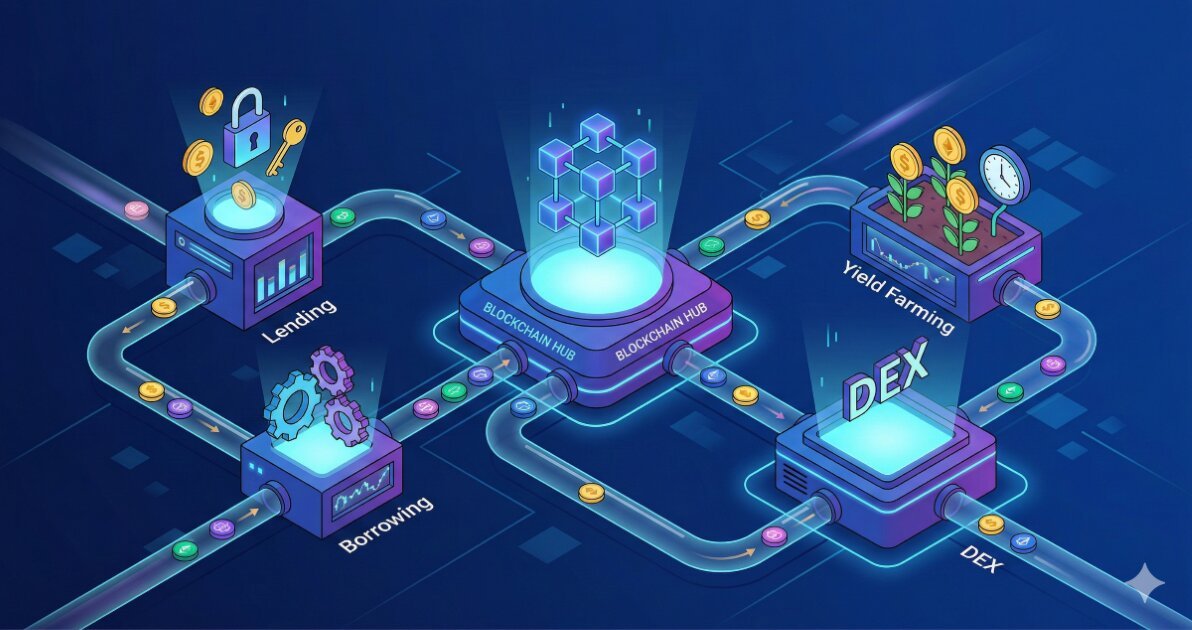
A decentralized exchange (DEX) settles trades through smart contracts. Users retain custody of their funds in self hosted wallets until the moment of swap execution. Uniswap, Curve, and dYdX represent different architectural approaches within the DEX category.
Automated market maker (AMM) DEXs like Uniswap and Curve replace the order book with liquidity pools. Liquidity providers deposit token pairs into a contract. The contract prices swaps using a formula, typically a constant product (x times y equals k) or a stableswap curve optimized for assets pegged to the same value. Each swap shifts the pool balance and adjusts the price algorithmically.
Order book DEXs like dYdX v4 maintain a limit order book but settle matched trades onchain or on an application specific blockchain. This hybrid model reduces latency compared to purely onchain order books while preserving noncustodial settlement.
Gas costs constrain DEX usability. On Ethereum mainnet, a simple token swap might cost 100,000 to 150,000 gas. At 30 gwei and an ETH price around historical averages, that translates to several dollars per trade. Layer 2 networks like Arbitrum and Optimism reduce costs by an order of magnitude, though crosschain bridge risk then enters the equation.
Order Matching and Price Discovery
Centralized exchanges use continuous limit order books. Makers post limit orders specifying price and quantity. Takers submit market orders or marketable limit orders that match against the best available bid or ask. The matching engine operates first in, first out within each price level.
Market orders on thin books create slippage. If the best ask has 0.5 BTC at 40,000 USD and you market buy 1 BTC, the engine matches 0.5 BTC at 40,000, then walks up the book to fill the remainder at progressively worse prices. Slippage percentage depends on order size relative to posted liquidity at each level.
AMM DEXs calculate execution price from pool reserves at the moment the transaction confirms. A swap of token A for token B pulls A from your wallet, adds it to the pool, and sends you B according to the bonding curve. Large swaps relative to pool depth push the price further, creating price impact distinct from gas fees. Frontrunning bots monitor the mempool and submit higher gas transactions to trade ahead of your swap, extracting value from the price movement your trade will cause.
Custody Models and Key Management
Centralized exchange custody relies on hot wallets for operational liquidity and cold storage for the majority of reserves. A typical setup keeps 5 to 10 percent of assets in hot wallets to process withdrawals without delay. Cold wallets use hardware security modules or multisig schemes where several keyholders must approve transfers.
Proof of reserves attestations attempt to verify solvency. An exchange publishes a Merkle tree of hashed account balances and a signed message from wallet addresses holding the reserves. Users verify their balance appears in the tree and that the published addresses control sufficient funds. This process does not reveal liabilities or off balance sheet obligations.
Self custody on DEXs shifts key management to the user. Losing a seed phrase means permanent loss of funds. No customer support can reverse a transaction sent to the wrong address or recover a wallet whose keys were never backed up. Smart contract wallets with social recovery or spending limits offer middle ground options, though they add gas overhead and dependency on guardian addresses.
Regulatory and Compliance Layers
Centralized exchanges implement Know Your Customer (KYC) and Anti Money Laundering (AML) controls. New users submit identification documents. Transactions above certain thresholds trigger enhanced due diligence. Sanctions screening blocks deposits and withdrawals from addresses associated with sanctioned entities or regions.
Travel rule compliance requires exchanges to share sender and beneficiary information for transfers above 1,000 USD (or equivalent regional threshold). This applies to withdrawals sent to another exchange or custodian, not to self hosted wallet addresses, though some jurisdictions are expanding scope.
DEXs do not inherently impose identity checks because no central operator controls access to the smart contract. Anyone with a compatible wallet can call the swap function. Some DEX front ends implement geoblocking or wallet screening at the interface layer, but users can interact directly with contracts using alternative front ends or command line tools.
Regulatory treatment of DEX protocols remains unsettled. U.S. enforcement actions have named both protocol developers and interface operators as defendants, arguing that deploying or maintaining exchange infrastructure constitutes operating an unregistered exchange. Other jurisdictions distinguish between protocol code and commercial operation of a trading service.
Worked Example: Limit Order Execution on a CEX vs. Swap on an AMM
You want to buy 10,000 USD worth of ETH.
On a centralized exchange, you check the order book depth. The best asks show 2 ETH at 2,000 USD, 3 ETH at 2,001 USD, and 5 ETH at 2,002 USD. You place a limit order to buy 5 ETH at 2,002 USD. The engine immediately matches 2 ETH at 2,000 and 3 ETH at 2,001, filling your order with an average price of 2,000.60 USD per ETH. The exchange updates your account balance in its database. No blockchain transaction occurs. Total cost: 10,003 USD plus the exchange’s trading fee, typically 0.1 to 0.5 percent.
On an AMM DEX, you connect your wallet to the interface. The contract holds a liquidity pool with 500 ETH and 1,000,000 USDC (constant product k equals 500,000,000). You request a swap of 10,000 USDC for ETH. The contract calculates the output: adding 10,000 USDC to the pool brings it to 1,010,000 USDC, so the ETH reserve must become 500,000,000 divided by 1,010,000 equals 495.05 ETH. You receive 4.95 ETH. Effective price: 2,020.20 USD per ETH. The price impact of your trade is approximately 1 percent. You also pay a 0.3 percent protocol fee (taken from the swap amount) plus gas, which might be 5 to 15 USD depending on network congestion. Your transaction settles in the next block.
The CEX offers better execution on this size. The AMM penalizes your swap because you are moving the pool. For smaller trades in highly liquid pools, the difference narrows.
Common Mistakes and Misconfigurations
- Assuming CEX account balances represent onchain holdings. Your account balance is a database entry. The exchange’s reserve wallet may hold the corresponding assets, or it may have lent or lost them. Proof of reserves does not guarantee you can withdraw.
- Ignoring slippage tolerance settings on DEX swaps. If you set slippage tolerance to 0.5 percent but market movement or frontrunning shifts the price by 0.6 percent between submission and confirmation, the transaction reverts and you pay gas for nothing.
- Using market orders on illiquid CEX pairs. A market order can execute at extreme prices if the order book is thin. Always check bid ask spread and depth.
- Sending tokens to a smart contract address on a CEX. Centralized exchanges generate deposit addresses for each user. Sending tokens to the exchange’s main contract or to another user’s address often results in permanent loss.
- Forgetting to account for gas price volatility on DEXs. A swap that costs 3 USD in gas at 20 gwei can cost 30 USD at 200 gwei during network congestion. Set gas limits and price caps, or use services that simulate execution cost before submitting.
- Trusting DEX front end price quotes as final. The displayed quote is an estimate based on current pool state. If another transaction alters the pool before yours confirms, you receive a different rate. Always set minimum output amounts.
What to Verify Before You Rely on This
- Current reserve attestation date and scope. Proof of reserves snapshots become stale. Check publication frequency and whether liabilities are disclosed.
- Withdrawal processing times and limits. Exchanges adjust daily and per transaction withdrawal limits. During stress events, processing delays extend from minutes to days or weeks.
- Jurisdictional licensing status. An exchange may operate legally in some countries but not others. Confirm registration with relevant financial authorities in your jurisdiction.
- Smart contract audit coverage and date. DEX protocol upgrades may introduce new contracts. Verify that the contract address you interact with has been audited and when.
- Fee schedule and tier structure. Trading fees vary by volume tier, order type, and token pair. API endpoints for fee estimation often differ from what the web interface displays.
- Token listing and delisting policies. Centralized exchanges can delist tokens with little notice, forcing liquidation or withdrawal. DEXs list tokens permissionlessly, but liquidity can evaporate.
- Insurance fund size and coverage terms. Some exchanges maintain insurance funds to cover losses from liquidation failures or security breaches. Coverage is typically partial and subject to terms you should read.
- Blockchain network the DEX operates on. Deploying on multiple chains means separate liquidity pools and different gas costs. Verify you are interacting with the correct network.
- Oracle source and update frequency for derivative DEXs. Perpetual and options protocols rely on price oracles. Understand which oracle feeds the contract and how often it updates.
- Geoblocking and compliance restrictions. Even noncustodial interfaces may block access from certain jurisdictions or wallet addresses flagged by compliance vendors.
Next Steps
- Compare execution quality across venues for your target pairs. Run identical order sizes on testnet or with small amounts to measure slippage, fees, and settlement speed.
- Audit your custody model against your risk tolerance. If you trade frequently, a CEX account with partial funds may suit you. If you hold long term, self custody or a multisig solution reduces counterparty exposure.
- Set up monitoring for onchain exchange reserves and protocol health metrics. Tools like DeFi Llama and Nansen track DEX liquidity and volume. Glassnode and similar services aggregate CEX reserve data from public disclosures and onchain movements.
Category: Crypto Exchanges