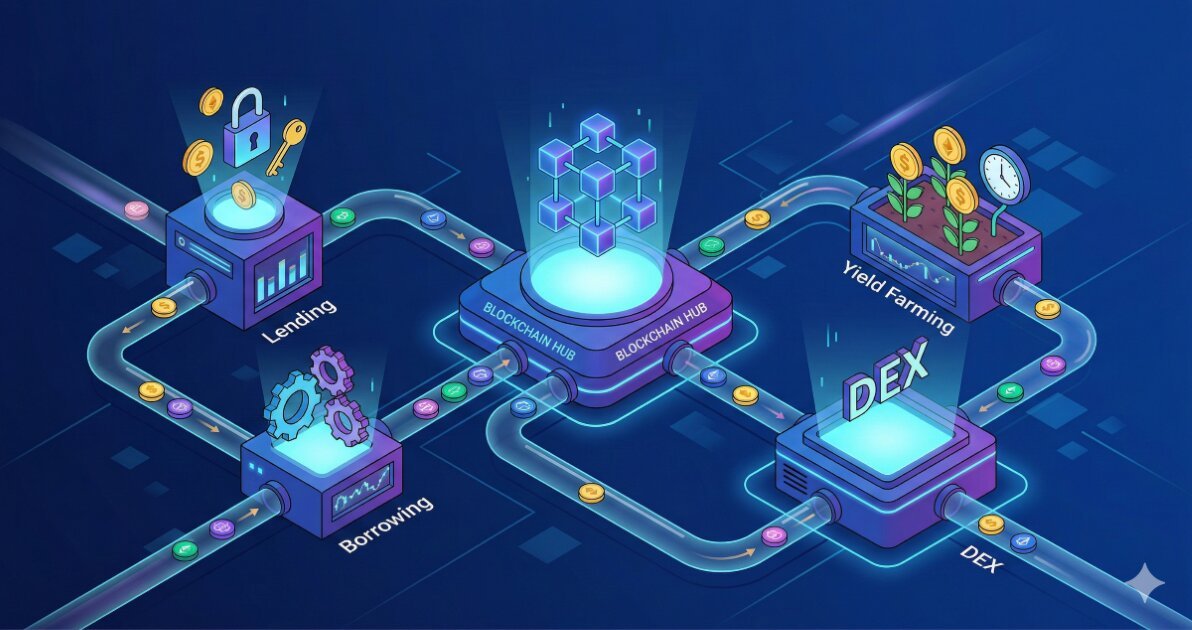
A white label crypto exchange is a turnkey or modular platform that you rebrand and operate under your own business entity. The vendor supplies the core infrastructure (matching engine, order book, custody integration, API layer, and often a frontend) while you control branding, user acquisition, compliance posture, and revenue splits. White label solutions compress the timeline from concept to live trading desk from 12 to 18 months of in-house development down to weeks or a few months, at the cost of vendor dependency and revenue sharing.
This article dissects the technical components, integration paths, operational constraints, and failure modes you encounter when deploying a white label exchange.
Core Components and Architecture Layers
A production white label stack typically comprises five layers.
Matching engine. Handles order placement, cancellation, and execution. High frequency operations require sub-millisecond latency. Verify whether the vendor runs a central limit order book (CLOB) or an automated market maker (AMM) hybrid. CLOB engines scale vertically and require careful sharding if you plan multi-region deployment. Some vendors expose matching engine logs via WebSocket for independent audit.
Custody and wallet infrastructure. Hot wallets service withdrawals, warm wallets handle intermediate balances, cold storage secures the majority. Confirm the key management scheme: are private keys held in hardware security modules (HSMs), multi-party computation (MPC) shards, or threshold signature schemes? Clarify liability: if the vendor custodies assets, you inherit counterparty risk. If you self-custody using the vendor’s wallet software, you own the operational security burden.
Liquidity provisioning. White label platforms rarely bootstrap deep native liquidity. Most aggregate external liquidity via API connections to Binance, Coinbase, Kraken, or decentralized exchange aggregators. This introduces routing latency and exposes you to upstream rate limits. Request logs showing fill rates and slippage distributions across liquidity sources during volatile periods.
Compliance and KYC/AML tooling. Providers bundle identity verification SDKs (Onfido, Jumio, Sumsub) and transaction monitoring (Chainalysis, Elliptic). Verify whether the vendor’s rule engine supports jurisdiction-specific thresholds (e.g., Travel Rule triggers at different fiat equivalents depending on the regulatory zone). Check if sanctions screening runs on deposit addresses or only on withdrawal destinations.
API and frontend. REST and WebSocket APIs expose trading, account management, and market data endpoints. The frontend (web and often mobile) is usually React or Vue based, skinnable via CSS and environment variables. Confirm the API rate limit structure and whether the vendor permits you to run your own caching layer.
Deployment Models and Control Trade-Offs
Fully hosted (SaaS). The vendor runs all infrastructure. You integrate via API and iframe or redirect for trading UIs. Fastest launch, minimal DevOps overhead, but you have zero visibility into database schema, no ability to tune matching engine parameters, and limited log access. Suitable if your priority is speed to market and you accept vendor lock-in.
Hybrid (managed cloud in your account). The vendor deploys the stack into your AWS, GCP, or Azure tenancy. You retain root access to logs, metrics, and database backups. Vendor provides updates via CI/CD pipelines you approve. This model preserves auditability and simplifies migration if you later bring operations in-house. Requires competent DevOps to monitor resource utilization and respond to scaling events.
On-premises or private cloud. Vendor delivers containerized images (Docker, Kubernetes manifests) and installation scripts. You operate everything. Maximum control, highest operational cost, and you assume responsibility for uptime SLAs and security patching. Rarely chosen unless regulatory or data residency mandates prohibit third party infrastructure.
Liquidity Integration Mechanics
Your order routing logic determines user experience. When a user places a market buy for 0.5 BTC, the system checks local depth. If insufficient, the router queries external APIs for quotes, aggregates responses, calculates net slippage, and either executes or rejects.
Worked example. A user submits a market order to buy 0.5 BTC. Your local book shows 0.2 BTC at $30,000. The router queries Binance API (0.15 BTC at $30,005) and Kraken API (0.15 BTC at $30,010). The aggregated fill is 0.2 BTC at $30,000, 0.15 BTC at $30,005, and 0.15 BTC at $30,010, for an average execution price of $30,005. The vendor’s fee structure may apply a markup (e.g., 10 basis points) on the aggregated rate, so the user sees an effective price of $30,008. The router executes three legs, reconciles settlement, and updates the user balance atomically. Confirm how the vendor handles partial fills if one upstream API times out.
Revenue and Cost Structure
White label agreements typically follow one of three models.
License fee plus revenue share. You pay an upfront setup fee (often $10,000 to $100,000 depending on customization scope) and ongoing monthly hosting fees. The vendor takes a percentage of trading commissions (commonly 20 percent to 50 percent). Clarify whether the share applies to gross fees or net after liquidity provider rebates.
Flat monthly SaaS fee. Predictable budgeting, but often coupled with volume caps. Exceeding the cap triggers overage charges or forced tier upgrades.
Hybrid. Setup fee, flat monthly base, and marginal revenue share above a volume threshold. Aligns incentives if you expect rapid growth.
Factor in hidden costs: compliance tooling subscriptions, liquidity provider API fees, withdrawal network fees (which you may subsidize or pass through), and DevOps labor if running hybrid or on-premises.
Edge Cases and Failure Modes
Upstream liquidity outage. If your primary liquidity feed drops during a volatility spike, users see stale quotes or rejected orders. Confirm the vendor’s failover logic: does it automatically route to secondary feeds, widen spreads, or halt trading?
Reconciliation drift. Custody balances, matching engine ledger, and user-facing account tables can desynchronize during high load or network partitions. Request details on the reconciliation daemon frequency and manual intervention procedures.
Regulatory perimeter shift. You launch in a permissive jurisdiction, then a new rule requires real-time transaction reporting or asset delisting. Verify whether the vendor’s compliance module supports config-driven rule changes or requires a platform upgrade.
Vendor insolvency or acquisition. If the vendor ceases operations, can you migrate user data and balances without service interruption? Request escrow arrangements for source code or database schemas.
Common Mistakes and Misconfigurations
- Underestimating KYC onboarding latency. Automated KYC may approve 70 percent of users instantly, but manual review queues for edge cases (non-Latin scripts, minor discrepancies) can delay onboarding by days.
- Ignoring API rate limit headroom. Vendor APIs often cap requests per second. Polling order status or balance updates too aggressively triggers throttling, degrading user experience.
- Misconfiguring withdrawal thresholds. Setting hot wallet auto-refill triggers too low causes frequent cold-to-hot transfers, increasing operational overhead and exposure window. Setting them too high risks hot wallet depletion during withdrawal spikes.
- Skipping multi-region latency tests. Users in Asia trading on a US-hosted platform experience 200 ms to 300 ms round trip times, unacceptable for high frequency strategies.
- Neglecting liquidity during low volume pairs. Aggregators may provide deep BTC and ETH books but thin or no coverage for altcoins, forcing you to manually source market makers.
- Accepting default fee tiers. Many vendors initialize trading fees at levels inconsistent with competitive exchanges, deterring volume.
What to Verify Before You Rely on This
- Current uptime SLA and historical incident logs from the vendor.
- Custody insurance coverage limits and underwriter identity.
- Compliance module update cadence and whether jurisdiction rule packs require separate licensing.
- API versioning policy and deprecation timelines for endpoints you integrate.
- Withdrawal processing SLA (manual approval queue depth and response times).
- Database backup frequency, retention period, and your access rights.
- Whether the vendor permits or restricts you from operating in specific jurisdictions.
- Smart contract audit reports if the platform supports token listings or DeFi integrations.
- Real slippage and fill rate metrics during the 2022 volatility episodes (if the vendor operated then).
- Migration or data export options if you decide to switch vendors or build in-house.
Next Steps
- Request a sandbox environment with live liquidity feeds and execute test trades across multiple pairs to observe routing behavior and latency.
- Draft a detailed compliance matrix mapping your target jurisdictions to the vendor’s supported KYC/AML features and identify gaps requiring third party add-ons.
- Model total cost of ownership over 12 and 24 months under low, medium, and high volume scenarios, incorporating setup fees, revenue share, liquidity spreads, and DevOps labor.
Category: Crypto Exchanges