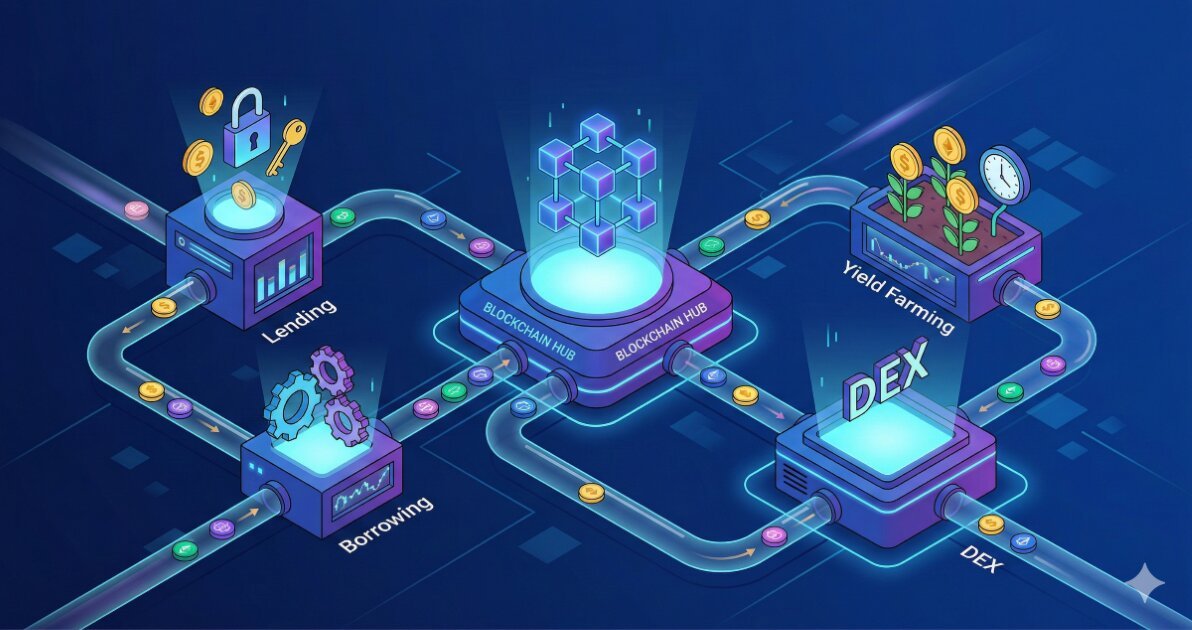
Raydium is a Solana based automated market maker (AMM) and order book protocol that bridges onchain liquidity pools with the central limit order book (CLOB) of OpenBook (formerly Serum). Unlike isolated AMMs, Raydium routes liquidity to OpenBook’s order book, allowing liquidity providers to capture fees from both AMM swaps and limit order fills. This article examines Raydium’s hybrid model, fee structures, concentrated liquidity options, and practical integration points for traders and protocol developers working in the Solana ecosystem.
Hybrid Liquidity Model and Order Book Integration
Raydium’s core design deposits LP token reserves into OpenBook markets as maker orders at the current pool price. When a taker order hits the OpenBook book, it can fill against Raydium’s liquidity. The AMM contract automatically adjusts these orders as the pool price moves, maintaining peg to the constant product curve (x * y = k for standard pools).
This routing serves two purposes. First, Raydium LPs earn fees from both swappers who interact directly with the pool and traders executing limit orders on OpenBook. Second, liquidity becomes visible to any application or bot monitoring OpenBook’s CLOB, increasing the effective depth available to market participants.
The integration depends on OpenBook market authority permissions. Raydium maintains accounts that hold base and quote tokens in each paired market. When the pool rebalances, the protocol cancels existing orders and places new ones at the updated price. This introduces a dependency: if OpenBook’s matching engine is congested or the market authority revokes permissions, Raydium’s ability to update orders degrades. Operators should monitor OpenBook network status alongside Raydium contract calls when building trading systems that assume tight spreads.
Standard and Concentrated Liquidity Pools
Raydium operates two pool types. Standard pools follow the Uniswap v2 constant product formula. Liquidity is distributed across the entire price curve from zero to infinity. These pools suit pairs with wide price ranges or tokens without established price floors.
Concentrated liquidity pools (CLMM) allow LPs to allocate capital within custom price ranges, similar to Uniswap v3. An LP providing SOL/USDC liquidity might restrict their position to a range of 20 to 40 USDC per SOL. Capital efficiency increases because the same quantity of tokens supports deeper liquidity within the active range. However, if price moves outside the range, that position stops earning fees and no longer contributes to swap depth.
CLMM pools introduce tick spacing and position management overhead. Each tick represents a discrete price point. Finer tick spacing (e.g., 0.01% increments) enables tighter ranges but increases the number of active positions the protocol must track. Coarser spacing reduces computation but limits precision. Developers integrating Raydium’s CLMM pools must account for range boundaries when estimating slippage. A large swap that exhausts liquidity in the current tick range will route through multiple ticks or fall back to standard pools, increasing effective slippage.
Fee Structure and Incentive Programs
Standard Raydium pools charge a 0.25% swap fee on each trade. Of this, 0.22% goes to LPs and 0.03% is allocated to a buyback mechanism or treasury, depending on governance decisions. CLMM pools allow variable fee tiers (commonly 0.01%, 0.05%, or 0.25%) set at pool creation. Tighter fee tiers attract volume for highly correlated pairs like stablecoin swaps, while wider tiers compensate for volatility risk in exotic pairs.
Raydium historically offered RAY token emissions to incentivize LP positions in select pools. Emission schedules and pool selection change according to governance votes. Current emission rates are not static and should be verified in the Raydium app or governance portal before committing capital. Staking RAY tokens may unlock additional rewards, but lock periods and unstaking penalties vary.
Fee accrual occurs per transaction. LPs receive their proportional share of fees automatically when they withdraw liquidity. There is no separate claim step for swap fees, but staking rewards and farm incentives require manual harvest transactions. Gas costs on Solana are low (typically under $0.01 per transaction), but frequent small harvests still erode net yield for smaller positions.
Slippage, Price Impact, and Routing Logic
Raydium calculates swap output using the constant product formula adjusted for fees. For a standard pool with reserves R_in and R_out, swapping amount A_in yields:
A_out = (R_out * A_in * 0.9975) / (R_in + A_in * 0.9975)
The 0.9975 factor accounts for the 0.25% fee. Price impact equals the percentage difference between the pre swap price (R_out / R_in) and the effective execution price (A_out / A_in).
Raydium’s router can split trades across multiple pools or route through intermediate tokens to minimize price impact. A BONK/USDC swap might route BONK to SOL, then SOL to USDC, if the combined impact is lower than a direct BONK/USDC pool. Routing decisions depend on real time liquidity depth. The router queries pool states onchain, calculates expected outputs for candidate paths, and selects the optimal route. This adds latency (typically one to three additional RPC calls) but can save 0.5% to 2% on large swaps through illiquid pairs.
Integrators using the Raydium SDK should set appropriate slippage tolerance parameters. A 0.5% tolerance may fail during volatile periods. A 5% tolerance exposes the transaction to front running or sandwich attacks. Dynamic slippage based on recent price volatility (e.g., standard deviation of minutely prices over the past hour) balances execution certainty against cost.
Worked Example: CLMM Liquidity Provision and Range Exit
Consider an LP providing 10 SOL and 300 USDC to a CLMM pool targeting a 25 to 35 USDC per SOL range. Current price is 30 USDC per SOL. The LP’s position supports swaps within this range.
-
A trader swaps 50 USDC for SOL. The pool price moves slightly upward. The LP earns fees proportional to their share of active liquidity in the current tick.
-
If SOL rallies to 36 USDC, the LP’s entire position converts to USDC. They now hold approximately 360 USDC (original 300 USDC plus value of 10 SOL at 36, minus fees and slippage). The position no longer earns fees until price returns to the 25 to 35 range.
-
If SOL falls to 24 USDC, the position converts entirely to SOL. The LP holds roughly 15 SOL. Again, no fees accrue until price reenters the range.
In both cases, the LP experiences impermanent loss relative to holding the original 10 SOL and 300 USDC. However, concentrated positions earn higher fee APYs during active periods, potentially offsetting impermanent loss if volume is sufficient and price remains rangebound.
Common Mistakes and Misconfigurations
- Ignoring tick spacing when setting CLMM ranges. Choosing boundaries that do not align with tick increments causes the transaction to revert or the protocol to round to the nearest valid tick, altering your effective range.
- Assuming OpenBook liquidity is always available. During network congestion or if OpenBook halts trading on a specific market, Raydium’s hybrid model loses half its depth. Check OpenBook market status before large trades.
- Using stale pool state for slippage calculations. Pool reserves update each block. A swap routed based on reserves from 10 seconds prior may encounter higher slippage if another transaction landed in between.
- Not accounting for minimum tick liquidity in CLMM pools. If your range is too narrow and volume is low, your position may sit idle for hours. Wider ranges or standard pools may yield more consistent fee income.
- Overlooking farm expiration dates. RAY emission schedules end on specific block heights. Continuing to provide liquidity after emissions stop means earning only swap fees, which may not justify the impermanent loss risk for volatile pairs.
- Front running exposure on high slippage swaps. Setting slippage above 2% on liquid pairs invites MEV bots to sandwich your transaction. Use private RPC endpoints or lower slippage with transaction retry logic.
What to Verify Before You Rely on This
- Current fee tier for the pool you intend to use (standard vs. CLMM, 0.01% vs. 0.25%).
- Active emission schedule for farms, including end block height and RAY tokens per block.
- OpenBook market status and order book depth for the paired token.
- Raydium SDK version and compatibility with your RPC provider (some nodes cache state longer than others).
- Minimum and maximum tick values for CLMM pools to ensure your desired range is supported.
- Governance proposals that may alter fee splits, emission rates, or treasury allocation.
- Network congestion on Solana, particularly transaction prioritization fees required for timely execution.
- Staking lock periods and unstaking penalties if you plan to stake RAY tokens for boosted rewards.
- Impermanent loss calculators or backtests for your chosen pair and range, using recent historical volatility.
- Any changes to OpenBook (formerly Serum) market authority or protocol upgrades that affect order placement permissions.
Next Steps
- Deploy a test transaction on Solana devnet using Raydium’s SDK to confirm routing logic and gas costs before mainnet execution.
- Compare effective APYs across standard and CLMM pools for your target pair over the past 30 days, factoring in both swap fees and emission rewards.
- Set up monitoring for pool reserve changes and OpenBook depth to trigger alerts when liquidity drops below your execution threshold.
Category: Crypto Exchanges